A student of mine, Ryan Melvin, has started a blog on data science and physics, which fits well with him being a PhD student in physics and an MS student in statistics. It’s in its infancy, but check it out. http://odsap.com
Author Archives: admin
Sabbatical!
Between summer research and my starting a semester sabbatical, I’ve been slow to post news or do anything on our website. Oops. I’ll try and do better. My sabbatical will be in residence, focusing on more time on research and grant writing, and hopefully avoiding being roped into any campus service work.
“Visualizing ensembles in Structural Biology”
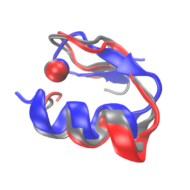
Ryan Melvin has his first publication with me, in the Journal of Molecular Graphics and Modeling. Titled “Visualizing ensembles in structural biology” it is a methods paper looking at using statistics to improve how we visualize macromolecular fluctuations. Check it out either on science direct or here.
Using integration to show that a force is non-conservative
Line integrals are handy; here is an application: showing that a force is non-conservative.
Series approximations in classical mechanics
As we know, it is easy to get unsolvable transcendental equations in classical mechanics, even if we can find solutions to the relevant differential equations. Here, Ryan Melvin demos how to use series approximations to find the range in a projectile motion problem with friction.
Taking the Curl of a gradient
Ryan Melvin has posted another Physics 262 video; this time reminding us how to to take the curl of a gradient.
at the March APS Meeting in Baltimore March 13-18th
Dr. Salsbury, fresh off an NIH fellowship panel, will be at the March Meeting of the American Physical Society March 13th-18th. He’s looking forward to checking out all the sessions of the Division of Biological Physics.
Springs in series and parallel
Have you ever wanted to know how to solve problems with springs hooked together in series and parallel? Ryan Melvin works them out right here for you.
Factoring to solve the critically damped harmonic oscillator
When a harmonic oscillator is critically damped, life becomes more complicated because the normal solution based on generalizing the simple harmonic oscillator — that is guessing an exponential solution — only has one root and so one solution. That can’t be correct for a second-order differential equation, so another solution needs to be derived. We […]
Gravitational waves exist! Go LIGO!
Completely different field in physics, but I can’t help be excited! A century after a prediction by Einstein, observations for 13.5 years, and development for a decade longer, finally gravitational waves were seen on September 14, 2015 @9:51AM UTC (4:51 pm EST). Of course, there is more to this than just the confirmation of a […]