So the website is fairly out-of-date now. A goal is to update it this semester and actually post news as well.
So what’s happening in the Salsbury Group this semester:
-
after multiple graduations, the group is the smallest its been in years; just Dr. Salsbury and a second-year grad student Dizhou Wu. Though there are collaborations with students in other research groups. Hopefully this will change soon, though the group has never been huge.
-
only three papers have come out so far this year, not surprising with people graduating and new collaborations and students; should change for 2020 and 2021.
-
a JPC B paper as part of a collaboration with former post-doc Yan Lu, who is currently a faculty member at Xidan University. In one of our few papers that isn’t either cancer-related or a methods paper, we look at the stuctural properties of the Aβ29-42 dimer embedded in fatty acid membranes, with an eye towards understanding the basic science behind Alzheimer’s .
-
Two papers on thrombin, which are interesting not-only for understanding thrombin but also for examination of allostery and because we put together a nice set of methods to examine these problems. Although thrombin is commonly thought as important for understanding cardiovascular and pulmonary disorders, our interests were sparked because of its potential role in tumor proliferation and angiogenesis.
-
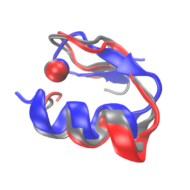
Our PCCP paper explore the role of sodium binding in the (generalized) allosteric response of thrombin. We did a very careful study of microsecond scale molecular dynamics simulations using correlation network analyses on dihedral angles and hidden Markov modeling to build up a detailed picture of Na+-binding and its effects including a hypothetic second sodium binding site.
-
Our JBSD paper, which is an earlier paper than the PCCP paper, but came out in print later, looks at the effects of a disease-associated single deletion mutation. We found quite distinct behaviors in the mutant, including both localized and long-range effects. In addition to more traditional methods, we used machine learning techniques, with decision-trees on hydrogen bonds being the most useful to hypothesize on the nature of the most critical hydrogen bond changes due to the mutation.
-
-
-
Dr. Salsbury is teaching two classes and as usual is organizing the SCB discussion group
-
Physics 113, the first semester calculus-based introduction which focuses on mechanics. Dr. Salsbury decided to switch texts to University Physics by Young and use a new online homework system, Mastering Physics.
-
This class has been a flipped class for years, but Dr. Salsbury will take advantage of a using a new text to revise his voicethreads and reassess his in-class questions.
- Most of this content is unfortunately hidden in Mastering Physics and Canvas.
-
-
Physics 770, graduate statistical mechanics. This has been moved back to being a Fall class, though will continue to be every-other year. Not much is new here, though the computational labs were revised considerably last time it was taught, so some refinement will need to be done. Much of this content is now hidden in Mastering Physics and Canvas.
-
SCB 701 only has one speaker in the Fall, because of a schedule conflict with our other slot, but as normal has several speakers in the Spring. We found years ago, it was more convenient with better attendance to have 2 in the Fall and 4 in the Spring. Unusually though the full schedule filled up fast!
-